Search On This Site

Showing posts with label Power Plant Engineering. Show all posts

Saturday, 23 January 2016

Innovative Flooded Steam Heat Exchanger - A Unique Vertical Steam HeatExchanger


Innovative Flooded Steam Heat Exchanger
If you are a designer that works for consultant engineer or mechanical you might have come across steam network system . Steam piping design is done the same way over the last 100 years or so.  The traditional way of design those steam heating system needs a lot of components like 2 (1/3-2/3) pressure reducing valve, 2 (1/3-2/3) control-valve on the steam heat exchanger, a steam relief valve hook to the roof which need maintenance annually and a dedicate condensate return pump with a vent pipe to the roof to eliminate all the flash in return condensate line in order to avoid any water hammer.


New steam heating system needs less equipment
No more pressure reducing valve, no more condensate pump and no more safety relief valve. 
This innovative vertical steam heat converter solution that not only avoid all those previous pieces of equipment but gives also energy savings up to 15%!
The steam system consist of using a vertical heat exchanger, build for steam process, with a small control valve install on the condensate return line.  By doing so, they flood the heat exchanger. That allows them to extract not only the latent heat but also the sensible heat which you don’t do when you use a traditional horizontal heat exchanger system.  And because they work on full pressure in the steam inlet, they don’t need a vacuum breaker, so they don’t inject oxygen in you return lines anymore.

It requires no safety valve to the roof
The vertical steam heat exchanger comes with an ASME  (CRN for Canada) stamp for high pressure vessel on the heat exchanger and all the other components.  This way the safety valve is not needed.
There is over 400 installations around United States and Canada. Mostly use in Hospitals, Colleges &Universities and some industry, this unique concept is the new way of designing steam network.

And the big question is why we didn’t do this before? 
Well if you take a look at the traditional manufacturer in the steam business, not only they offer heat exchanger concepts but also all the components needed to make this work, so by pushing this type of concept (flooded steam heat exchanger) they will lose a lot of return business in maintenance over years. Like the pressure reducing valves and steam condensate pumps.

Maxi-Therm is a new player in the steam market, not only they manufacture building heat and domestic hot water system but also a clean steam generator and a condensate mixer that avoid the needs of multiple condensate return lines.  They simply offer all the solutions to have a 100% close loop on steam with no vents to the roof or the wall. 


To know more about Maxi-Therm visit www.maxi-therm.net. (514) 351-1001

Friday, 18 September 2015

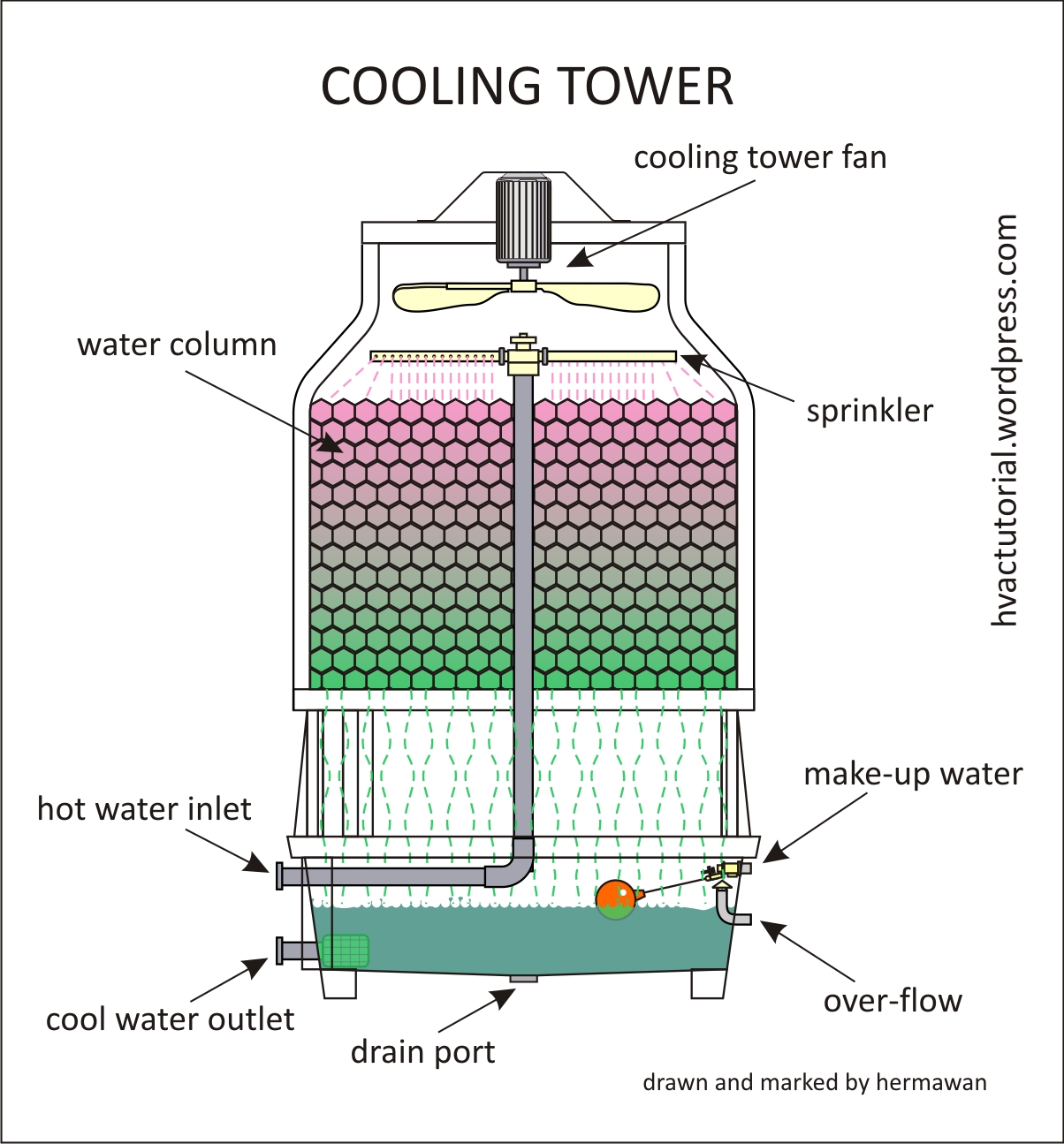
Cooling Tower


Cooling tower are very important part of many chemical plants. primary task of cooling tower is to reject heat into the atmosphere.


Cooling Tower Type:

Mainly there is two type : Natural draft and mechanical draft

Natural draft cooling tower are large in construction and mainly use for water flow rate more than 45000 m^3/hr.

There are three arrangement in mechanical draft:

1. Counter Flow induced draft
2.counter flow forced draft
3.cross flow induced draft

Main component of cooling tower:

Frame and casing, fill, cold water basin, drift eliminator, air inlet, louvers, nozzles and fan.

Wednesday, 2 September 2015

Basic Of Steam Turbine

The steam turbine is universally used as prime mover in steam power plants.

Flow over Blades:

The steam turbine obtains its motive power from the change of momentum of a jet of steam flowing over a curved blade. The steam jet, in moving over the curved surface of the blade, exerts a pressure on the blade owing to its centrifugal force. This centrifugal force is exerted normal to the blade surface as shown in figure and acts along the whole length of the blade.

The resultant of these centrifugal forces plus the effect of change of velocity is the motive force on the blade. It should be realized that the blade obtains no motive form any impact of the jet, because the blade is so designed that the steam jet will glide on and off the blade without any tendency to strike it. In principle, it is analogous to a train passing around a railway curve. The train exerts a radially outward force on the line due to the centrifugal force.

Moving and Fixed Blades

In a steam turbine, a number of small blades are fixed to the ring of a revolving wheel or rotor. Jets of steam of a high velocity are obtained by expansion through nozzles and are directed on to the blades. The effective force of these jets, acting on the blades, rotates the wheel.

In modern turbines several of the wheel of moving blades are keyed to the same shaft, having a ring of fixed blades between each wheel of moving blades. These fixed blades are fixed to the turbine casing. Their object is to receive the steam jet from the moving blade ring and to divert it on to the next ring of moving blades by changing its direction as shown. This diversion may continue over several rings of moving and fixed blades until the whole of the kinetic energy of the steam jet is expended.

Friday, 3 July 2015

What Is Boiler? | Boiler Classification | Introduction To Different Types Of Boiler

What Is Boiler?

A boiler is a closed vessel in which water or other fluid is heated. The heated or vaporized fluid exits the boiler for use in various processes or heating applications.


Boilers can be classified as follows:

1. According to the flow of water and hot gases – fire tube (or smoke tube) and water tube boilers.

In fire tube boilers, hot gases pass through tubes which are surrounded with water. Examples: Vertical, Cochran, Lancashire and Locomotive boilers. There may be single tube as in case of Lancashire boiler or there may be a bank of tubes as in a locomotive boiler.

In water tube boilers, water circulates through a large number of tubes and hot gases pass around them. Eg., bobcock & Wilcox boiler.

2. According to the axis of the shell – vertical and horizontal boilers. 

3. According to location or position of the furnace. Externally and internally fired boilers.

In internally fired boilers, the furnace forms an integral part of the boilers structure. The vertical tubular, locomotive and the scotch marine boilers are well known examples.

Externally fired boilers have a separate furnace built outside the boiler shell and usually below it. The horizontal return tube (HRT) boiler is probably the most widely known example of this type.

Introduction To Power plant Engineering | Steam Power Plant | Diesel Power Plant | Nuclear Power Plant | Gas Power Plant | Hydro Power Plant

A power plant may be defined as a machine or assembly of equipment that generates and delivers a flow of mechanical or electrical energy. The main equipment for the generation of electric power is generator. When coupling it to a prime mover runs the generator, the electricity is generated. The type of prime move determines, the type of power plants.

Following Are The Different Types Of Power plant.

1. Steam power plant
2. Diesel power plant
3. Gas turbine power plant
4. Nuclear power plant
5. Hydro electric power plant

Related Posts Plugin for WordPress, Blogger...