This Video Show How To Make Horizontal Drum And Nozzle Orientation.
Sunday, 29 November 2015

Thursday, 24 September 2015
NDT- Non Destructive Testing
Nondestructive testing - NDT - use test methods to examine an object, material or system without impairing its future usefulness. Non-destructive testing is often required to verify the quality of a product or a system. Commonly used techniques are
AET - Acoustic Emission Testing
Acoustic Emission Testing takes advantage of the sharp sound that PCCP emits when it breaks or slips to identify areas of active distress within a construction. AET can be used to verify the structural integrity of pressure vessels, spheres, high temperature reactors and piping, coke drums, above ground storage tanks, cryogenic storage tanks and more. The inspection is executed externally and shut-down of the process may often not be necessary.
ART - Acoustic Resonance Testing
After an impact a specimen will vibrate in certain characteristic modes and frequencies that can be measured by a microphone or laser vibrometer. Acoustic sonic and ultrasonic resonance analysis is a non-destructive testing technique that allows testing of a wide range of test objects. Typical detecting faults are cracks, cavities, detached layers, material inconsistencies, hardness deviation in materials.
Tuesday, 22 September 2015
Utility Piping | Steam Piping - Steam Heating
In Previous Article We seen the different use and types of steam.
We know the dry saturated steam is generally used in pipe heating process.
Steam is one of the most common and effective heat transfer mediums used in industry, but it is not the only medium available. Other fluids such as hot water and oil are also used for indirect heating in heat exchangers.
So following are the advantages of steam heating:
In case of heating with hot water it only loose sensible heat around 17kcal/hr But if we use dry saturated steam then it loose latent heat around 539kcal/hr.
 So we can see the use of the steam is more preferable in case of pipe heating.
Utility Piping | Steam Piping - Basic Of Steam
What Is Steam
In a simple word Steam is the gas formed when water passes from the liquid to the gaseous state.
The process of formation of steam can be explained as,
In liquid water, H2O molecules are constantly being joined together and separated. As the water molecules are heated, however, the bonds connecting the molecules start breaking more rapidly than they can form. Eventually, when enough heat is supplied, some molecules will break free. These 'free' molecules form the transparent gas we know as steam, or more specifically dry steam.
So there are main two form of the steam: Dry steam and wet steam
Steam is Called Dry steam when all its water molecules remain in the gaseous state. It's a transparent gas.
And is called as Wet Steam When Is Contain water particles in it.
Because there are various form of the steam so according to the phase of steam use is different.
Friday, 18 September 2015
Cooling Tower
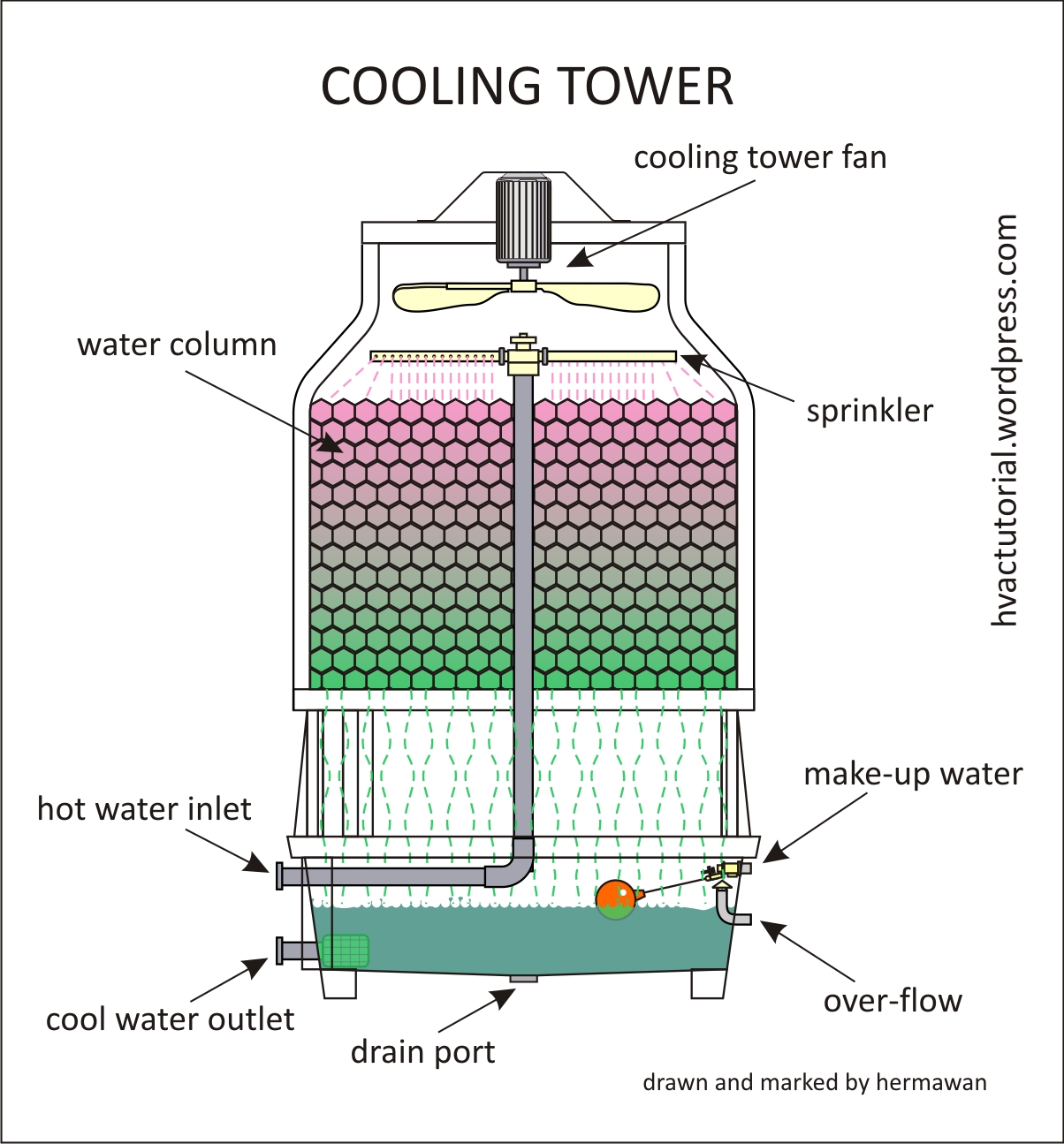
Cooling tower are very important part of many chemical plants. primary task of cooling tower is to reject heat into the atmosphere.
Cooling Tower Type:
Mainly there is two type : Natural draft and mechanical draft
Natural draft cooling tower are large in construction and mainly use for water flow rate more than 45000 m^3/hr.
There are three arrangement in mechanical draft:
1. Counter Flow induced draft
2.counter flow forced draft
3.cross flow induced draft
Main component of cooling tower:
Frame and casing, fill, cold water basin, drift eliminator, air inlet, louvers, nozzles and fan.
Subscribe to:
Posts (Atom)
